
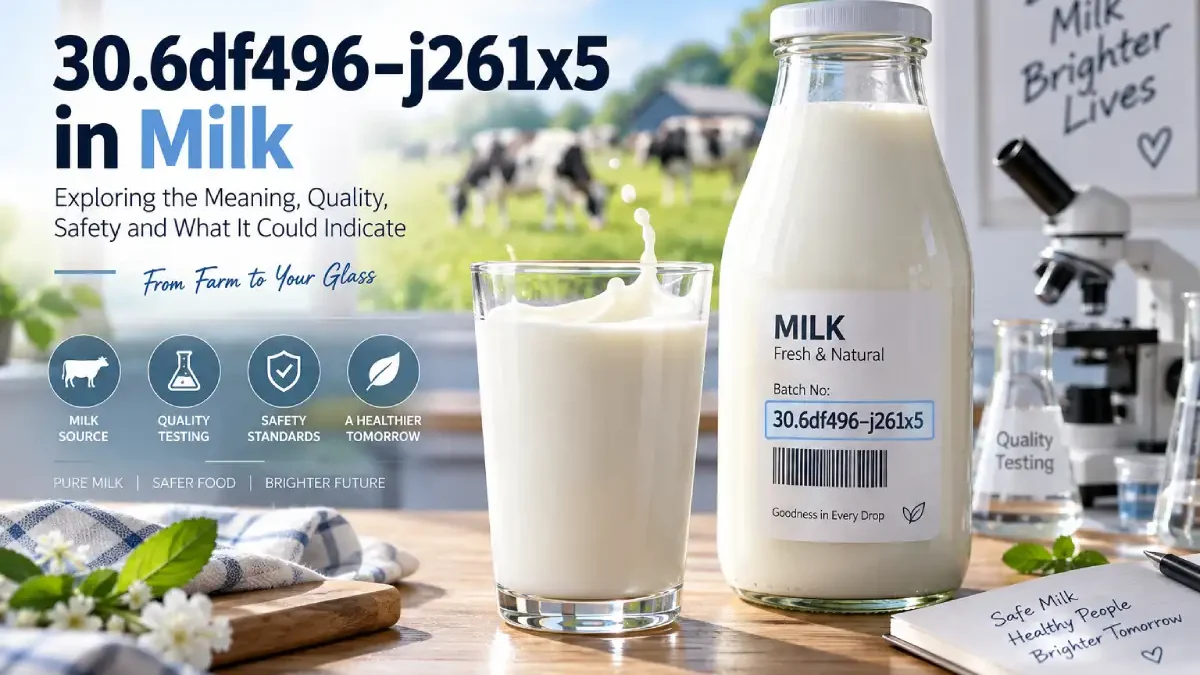

Milk. It’s one of the simplest foods, used in virtually every facet of our daily lives. The technologies employed in testing it, the processing to make it, the packaging, and the methods used to trace its progress, though, can be surprisingly complicated, and that’s where one sees odd letter-and-number codes creep into everyday conversations about milk; one of those is “30.6df496-j261x5 in milk.”
The form appears to be a chemical equation, an additive to food, or part of the results of some laboratory testing; however, it is crucial to differentiate 30.6df496-j261x5 from a legitimate, catalogued ingredient to be found in any milk production, or any officially listed and unanimously accepted dairy-quality characteristic. It may be referred to as a “technical identifier during monitoring of milk testing and quality” in several online documents; however, none provide an actual definition.
Understanding that difference is the best place to begin.
Table of Contents
What Does 30.6df496–j261x5 in Milk Mean?

The string of characters 30.6df496-j261x5 is a phrase appearing within milk contexts. An alphanumeric string is merely an arrangement of both letters and numbers that have typically been artificially generated and used to tag/label a record, sample, batch, task, entry, etc.
Certain online sites speculate that this alphanumeric string refers to a milk-quality test, -a quality measurement that can be measured numerically-e.g., fat, protein, nutritional components of the milk, microbes present, fresh life/shelf-life of the milk, etc.
But there is very little indication that a standardized measurement within the milk and dairy industry has an alphanumeric string of precisely 30.6df496-j261x5.
That matters because milk laboratories normally rely on established analytical methods and clearly defined measurements rather than unexplained codes. A mysterious identifier should therefore be treated as a possible internal reference unless its source confirms otherwise.
Why Does the Code Look Like a Technical Measurement?
The structure of the expression naturally creates confusion:
| Part | What it looks like | Possible interpretation |
| 30 | Number | Could be a value, batch reference, or category |
| .6 | Decimal-style section | Could resemble a measurement or version |
| df496 | Mixed characters | Could be an identifier |
| – | Separator | Divides two sections |
| j261x5 | Alphanumeric sequence | Could be a secondary reference |
Appearance alone can be misleading without an interpretation. A number is not inherently nutritional information in the context of a code, just as a letter-based character string does not always designate a chemical element. Complex codes exist primarily because computers require stable methods of identification.
Is 30.6df496–j261x5 a Milk Ingredient?

There is no reliable evidence that 30.6df496–j261x5 is a conventional milk ingredient.
Milk contains naturally occurring components: water, lactose, proteins, fats, minerals, and vitamins. The additional substances that are added are known as permitted ingredients or process aids that would also usually be in a recognizable chemical, regulatory, or commercial name.
However, the odd string of numbers would not necessarily be a milk nutrient or food additive. An online search for the term (even recently) shows it is not a food component or a permitted additive code.
Therefore, it would be dishonest to call the number itself something that is added into the milk.
Could It Be a Quality-Control Reference?
This could also have been the most feasible option, though it would need to be confirmed.
In on-farm dairy production, quality control systems are extensive, and milk can be checked for composition, microbiological quality, temperature, adulteration, and/or contaminants in various respects. The samples are able to be labeled with an ID number, allowing staff in the laboratory to link a test to the appropriate batch or production cycle.
An internal staff number could seem anomalous to an outsider.
For example, a laboratory might use a code to connect:
- a milk sample with a collection date;
- a production batch with a test report;
- a delivery with a supplier;
- a laboratory sample with its analytical results;
- a processing run with quality-control records.
That does not mean that 30.6df496–j261x5 specifically performs any of these functions. It simply explains why an unfamiliar code might appear beside information about milk.
How Is Milk Quality Normally Evaluated?
Milk quality is not determined by one mysterious number. It involves several characteristics that work together.
Fat and Protein
Fat and protein are important parts of milk composition. Their levels can vary naturally according to factors such as breed, animal nutrition, stage of lactation, and processing.
Microbial Quality
Microbiological testing helps identify whether milk has been handled under appropriate hygienic conditions. High microbial counts can indicate problems with sanitation, storage, or temperature control.
Freshness
Freshness is closely connected with storage temperature, handling, packaging, and the time between production and consumption.
Adulteration Testing
Milk may also be examined for unwanted substances or adulteration. Such testing is particularly important because consumers expect dairy products to meet established safety and quality requirements.
These are recognized concepts in dairy quality control. They are much more meaningful than assigning an unsupported definition to an unfamiliar code.
30.6df496–j261x5 Compared With Ordinary Milk Information
| Feature | 30.6df496–j261x5 | Conventional milk information |
| Appearance | Unusual alphanumeric code | Clear names and measurements |
| Recognized ingredient? | Not established | Milk contains known nutrients and components. |
| Standardized meaning? | No verified universal meaning | Many quality measurements are standardized. |
| Possible purpose | Could be an internal reference | Nutrition, quality, safety, labeling, or traceability |
| Consumer interpretation | Should not be guessed | Usually explained on packaging or documentation |
This comparison highlights an important point: a code should not be interpreted simply because it appears next to the word “milk.”
Why Are People Searching for This Term?
Unusual terminology often becomes popular when a phrase appears in search results, social media posts, technical documents, or automatically generated online content.
Once a strange expression begins circulating, different websites may give it completely different explanations. In fact, recent pages discussing 30.6df496–j261x5 describe it variously as a technical identifier, food-related term, and potential quality-tracking reference.
That inconsistency is itself useful information.
When reliable sources disagree about what a code means, the sensible approach is not to choose the most detailed explanation. Instead, the source should be located.
How to Verify 30.6df496–j261x5 on a Milk Product
If the code appears on a milk carton, laboratory report, receipt, or other document, context becomes extremely important.
First, check the surrounding text. A code printed near “batch,” “lot,” “production,” or “sample” is more likely to be a traceability reference than an ingredient.
Next, check the manufacturer’s documentation. A genuine product code can usually be explained by the company that produced or printed it.
If the term appears in a laboratory report, ask the laboratory what the identifier represents. Laboratory codes are often meaningful only within that laboratory’s information system.
Finally, avoid consuming or adding an unidentified substance simply because an online article claims that it is associated with milk.
Is 30.6df496–j261x5 Safe?
It would be inappropriate to label the code itself as either safe or unsafe because a code is not necessarily a physical substance.
If the expression is merely an internal identifier, there is nothing to consume. If it is purported to be a chemical, additive, or treatment, its actual identity must be established before any safety assessment can be made.
This is especially important with food. Claims about an unknown substance should ideally be supported by a manufacturer, laboratory, scientific publication, or relevant food-safety authority rather than an unexplained blog post.
Final Thoughts
“30.6df496-j261x5 in milk” may look somewhat official, and somewhat abnormal, but the presence of these unusual characters does not indicate it is a chemical, additive, nutrient, or officially recognized way to evaluate milk quality. The only reasonable meaning is that it is an informal, unverified code that relies on the context to give it meaning. There appears to be an online connection between milk-quality analysis and laboratory operations, but further inquiry does not reveal any formal definition or designation within the food industry.