
Cosmetic surgery operations have increased considerably in recent years, although their peak occurred in the 50s of the last century. For twenty years, new procedures and techniques have developed that have allowed aesthetic operations to carry out with an infinity of improvements implemented and with a considerable reduction in pain in the surgical intervention and the postoperative process—prestigious professionals in the sector, such as Drab. García-Dihinx is responsible for including these new techniques effectively in their clinics.
Table of Contents
History of Plastic Surgery Boom
Admin27 September 2019 There Are No Comments in Body Surgery, Facial Surgery, Other Articles when we talk about Plastic, Aesthetic, or Reconstructive Surgery, we refer to the speciality of surgery whose objective is to restore anatomical integrity to the body or correct any physical alteration or defect.
During the last century, cosmetic surgery interventions have increased almost exponentially. This is due, amongst other reasons, to the new techniques that facilitate the patient’s recovery-the increase in interventions for male patients and their accessibility to people with different economic resources. These factors have contributed to democratizing this type of surgery, allowing thousands of patients to alleviate other physical defects that are often sources of complexity and loss of confidence. However, one should remember that the search for a beautiful or even normal appearance is constant in different human civilizations.
Plastic Surgery Today
This type of surgery reached a remarkable development during the second half of the 20th century thanks to the new techniques, procedures, and materials.
Recent advances have made the intervention and the postoperative period comfortable and painless for patients. Many people also combine surgery with innovative skin care treatments for face and body to keep results looking natural longer.
Logos Plastic surgery today encompasses cases of burns, reconstructions, correction of malformations, etc. It is a unique speciality because its field of action is not limited but encompasses different minor things.
Why Cosmetic Surgeries Increased the Pandemics?
Different reasons justify the increase in cosmetic surgery interventions during the pandemic.
It must recognize that there is an essential economic factor. The confinement, the impossibility of travelling, and the limitations in leisure have meant that many people have been able to save more and, finally, have encourages to do something for themselves.
At the same time, teleworking, spending more hours at home, and reducing social life facilitate recovery. Until the outbreak of Covid-19, many people waited to have surgery in the summer, Easter, or the Christmas holidays.
In this way, they could count on a few extra days to recover from cosmetic surgery calmly at home, without the pressure of going to work.
The Rise of Plastic Surgery Boom among Men.
This last year, the percentage of surgeries performed on men has increased again compared to the previous year, according to the latest publications of the Spanish Society of Reconstructive and Aesthetic Plastic Surgery. This increase has become a constant in recent years and is expected to increase yearly.
The concern for body image, cultural and social changes and greater access to information have brought men closer to the plastic surgery consultation, the three main reasons for consultation being the following:
Liposuction: the presence of localized fat is the main reason for consultation in both women and men, with no differences in the treatment between the two or in the objectives.
Otoplasty or surgery for prominent ears: the high incidence of this type of surgery is probably due to the more common short haircut in men.
Blepharoplasty or eye surgery: men consult due to tired eyes and eyelid bags just like women, but they usually consult later with more advanced degrees of blepharochalasis or excess skin on the eyelids and fat bags.
The Ancient History of Cosmetic Plastic Surgery Boom
Looks matter more to us than we’d like to admit. It is already instilled in us in childhood stories, in which, with Shrek’s permission, the witch is old and ugly, and the prince or princess is young and beautiful. And we drag it as we grow in the personal and work fields. How do you explain that the most attractive candidates get jobs more often than others who are perhaps more competent but physically less attractive?
- No Magic Mirrors
The cult of beauty is not something new. The difference is that today there is a wide range of techniques to apply to countless parts of the human body. Plastic surgery treats congenital anomalies and those derived from accidents and diseases. Aesthetics deals with the natural ones (a “too small” breast…) and the signs of ageing (crow’s feet, sagging arms…). The search for ways to stay beautiful has its wrinkles. - The Stigma of the Nose
Syphilis, a disease imported from the New Continent, caused havoc among the population. It also embarrassed those who suffered from it by deforming their noses—many of those affected sought. In the decorative Chirurgie a remedy to go unnoticed in society. Gaspar Tagliacozzi, Professor of Surgery at the University of Bologna, noted. The relationship between having a deformed nose or even having lost it with unhappiness. “A person without a nose is bound to be unhappy,” he said. - In Search of Inner Beauty
Cosmetic surgery has ceased to be an exclusive option for the rich and famous to become a massive phenomenon. The increasingly advanced techniques, the best results, and the absence of pain. The reduction of scars encourages more and more people to go through the operating room. - Goodbye to Impossible
The appearance of anaesthesia in 1844 and antisepsis in 1867 marked. In a turning point in the history of cosmetic surgery. If favouring operations by desire rather than necessity. This was the case with the mutilation during the First World War. Until then, surgeons had focused solely on reconstructing riddled and deformed body parts. Now they also took into account aesthetic criteria to minimize the severe psychological consequences for the soldiers.
Latest Numbers and Trends (2025–2026)
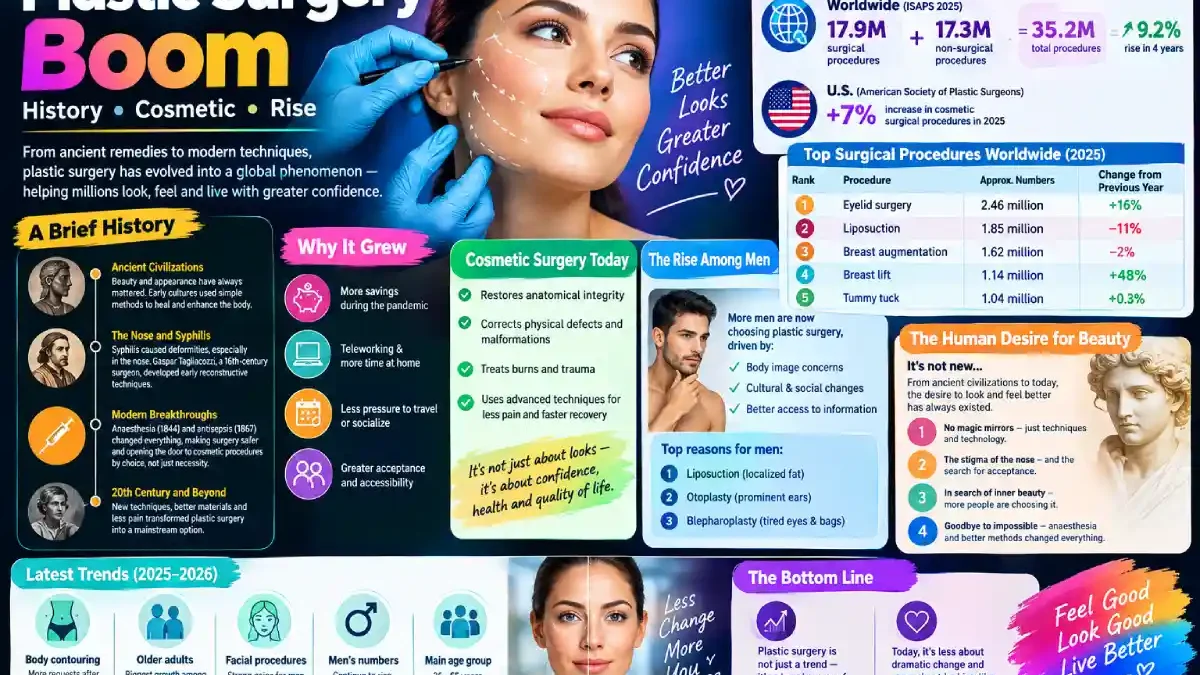
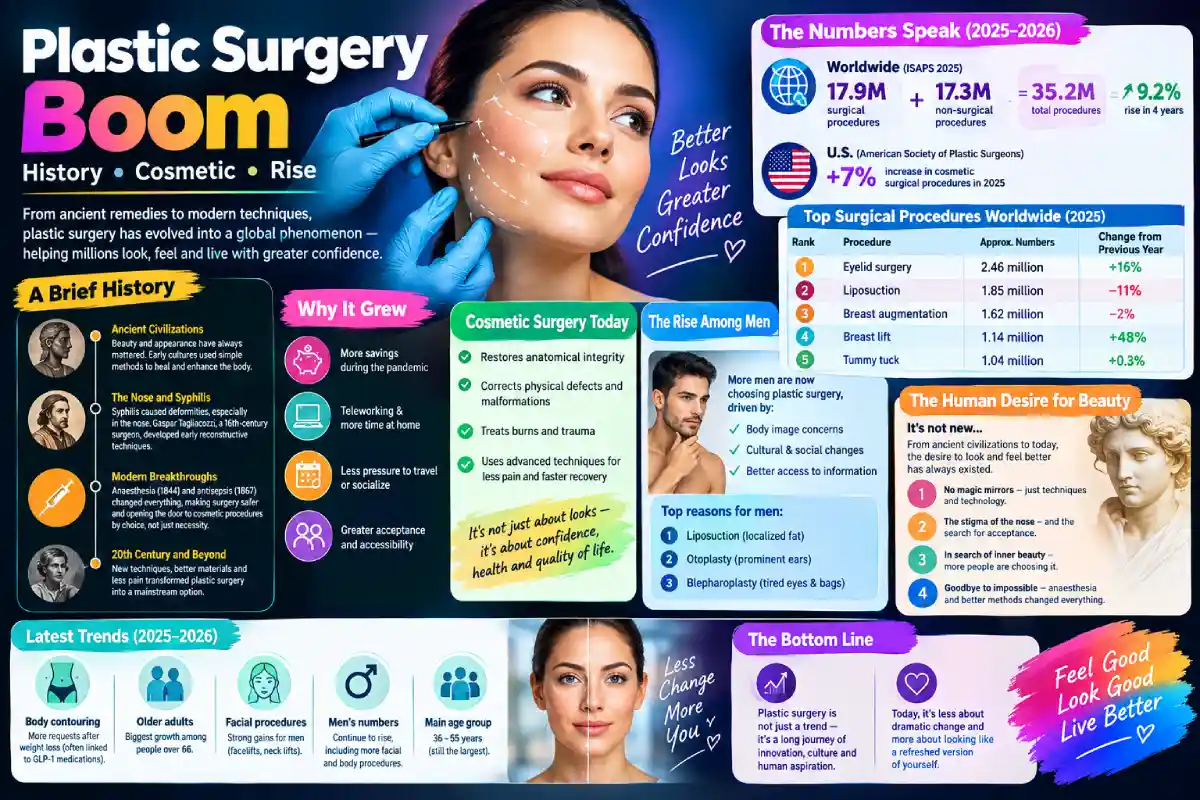
The boom has not slowed down. According to the latest global data from the International Society of Aesthetic Plastic Surgery (ISAPS) for 2025, plastic surgeons performed nearly 17.9 million surgical procedures and 17.3 million non-surgical ones worldwide. That is more than 35 million aesthetic procedures in total, with a 9.2% rise over the past four years.
In the United States, the American Society of Plastic Surgeons reported a 7% increase in cosmetic surgical procedures in 2025.
Here is a simple look at the top surgical procedures worldwide in 2025:
| Rank | Procedure | Approximate Numbers | Change from Previous Year |
| 1 | Eyelid surgery | 2.46 million | +16% |
| 2 | Liposuction | 1.85 million | –11% |
| 3 | Breast augmentation | 1.62 million | –2% |
| 4 | Breast lift | 1.14 million | +48% |
| 5 | Tummy tuck | 1.04 million | +0.3% |
What stands out is the big jump in breast lifts and the continued strength of eyelid surgery. Face and head procedures grew overall, while some body procedures cooled a little.
Men continue to make up a larger share of patients. In many clinics the number of male patients has risen steadily, driven by the same reasons seen years ago—localized fat, eyelid bags, and a desire to look rested and competitive at work. Facial procedures for men, including facelifts and neck lifts, have shown some of the strongest percentage gains.
Another recent shift is the rise in body-contouring surgeries after significant weight loss, often linked to the widespread use of GLP-1 medications. Surgeons report more requests for arm lifts, thigh lifts, and full body lifts as people want their skin to match their new shape.
Patients between 36 and 55 still make up the largest group, but the biggest year-over-year growth is happening among people over 66. Older adults are choosing eyelid surgery, facelifts, and fat grafting more than ever before.
Overall the trend feels more about restoration than dramatic change. People want to look like a refreshed version of themselves rather than a completely different person.
Conclusion
Plastic surgeons are part of a speciality whose history goes back hundreds of years. To the remotest times of prehistory. Where the art of healing was born as an instinctive reaction against accidents that required individual and immediate. If an action or as a form of coping with something unknown that had invaded a person.